Published April, 2017
From ECW Press
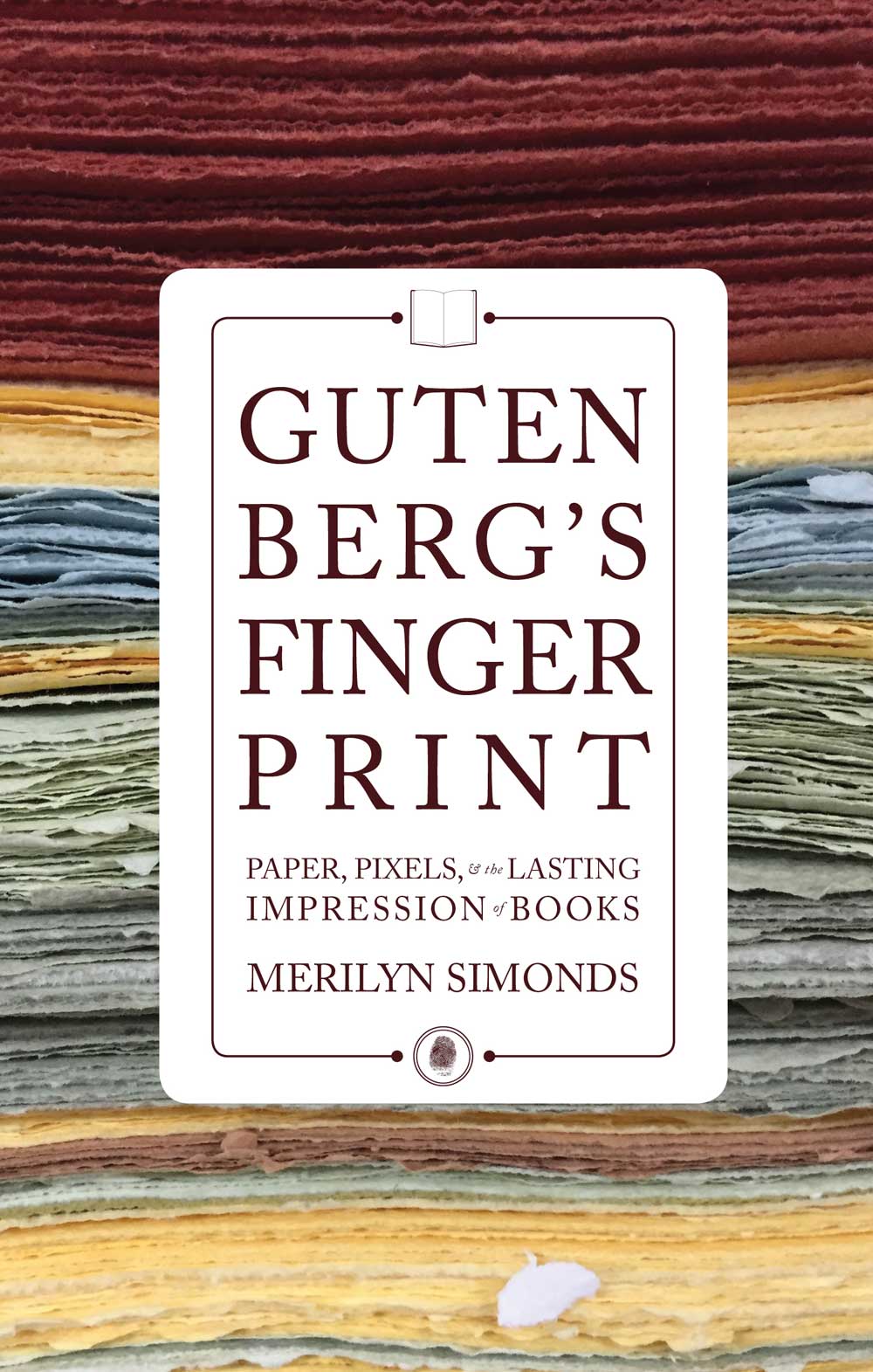
Four seismic shifts have rocked the history of human communication: the invention of writing, the invention of the alphabet, the invention of mechanical movable type that made the printing press possible, and the invention of the internet. Poised over this fourth transition, e-reader in one hand, a perfect-bound book in the other, Merilyn Simonds—author, literary maven, and early adopter—asks herself, What is lost and what is gained as paper turns to pixel?
Gutenberg’s Fingerprint trolls the past, present, and evolving future of the book in search of an answer. Part memoir and part philosophical and historical exploration, the book finds its muse in Hugh Barclay, who produces gorgeous books on a hand-operated antique letterpress. As Simonds works alongside this born-again Gutenberg, and with her sons to develop digital and audio editions of her flash-fiction stories, The Paradise Project, her assumptions about reading, writing, the nature of creativity, and the value of imperfection are toppled.
Gutenberg’s Fingerprint is a timely and fascinating book that explores the myths, inventions, and consequences of the digital shift and how we read today.
Order Gutenberg’s Fingerprint from ECW“Avoiding all reference to a foretold apocalypse, and firmly this side of idolatry, Gutenberg’s Fingerprint is a wise love letter to the printed page, as trustworthy as paper and as true as ink.”
– Alberto Manguel, A History of Reading and The Library at Night
“This erudite and charming book shows Merilyn Simonds at her best, giving us the history of the printed book as well as the future potential of digital books through the prism of her own publishing experience.”
– Kate Pullinger, Inanimate Alice and The Mistress of Nothing
“From papyrus to pixels, Merilyn Simonds is the perfect voice for how we read and write today. Her buoyant engagement with two simultaneous projects, the publishing of an ebook and the handsetting of the same book on letterpress, provides a fascinating lens into the feel, look, texture of words—from ancient scrolls to the scrolling screen. Gutenberg’s Fingerprint is much like Simonds’ beloved garden: casually but deliciously informative, a feast of facts about paper, ink, and digital technology. Simonds’ superb enterprise is both full of techie gusto and a sympathetic tolerance for the mistakes that only a letterpress lover can know.”
– Molly Peacock, The Analyst: Poems and The Paper Garden
“An entertaining history of book production and reading–a surprisingly fun read”
– Booklist
“A deeply enjoyable read”
– Laura Brady, ebook designer
49th Shelf Most Anticipated: Our Spring 2017 Non-Fiction Preview
“Simonds has mixed a perfect book together–no matter what format a reader uses.”
–Steven Buechler
The Library of Pacific Tranquility
“I love this book deeply...[it] is about making books, yes, but it’s about so much more. It’s a love letter to books, to words, to paper, to the Muse, to taking time to revise, to craft things with care, but it’s even more so a love letter to how interconnected we all are, if we are open enough to see it, if we let out hearts go first, so that our heads follow just a little bit behind. There’s the magic of it all.”
–The Republic of Poetry
kimfahner.wordpress.com/2017/07/19/merilyn-simonds-gutenbergs-fingerprint-a-love-letter-to-making-books
“A gorgeous meditation on the past, present, and future of books…The challenges and contrasts are striking, but Simonds reconciles them in ways that make claims of the death of books seem entirely premature.”
–Ottawa Magazine
ottawamagazine.com/arts-and-culture/jasmine-revolution-1980s-new-york-david-johnston-summer-reading-is-underway/
“Merilyn Simonds’ seventeenth and latest book, Gutenberg’s Fingerprint, fits firmly and delightfully in the genre of bibliomemoir…a nimble work—part history, part memoir, part technical manual, part tribute—that makes important connections between our reading past and present that we can and should carry into the future.”
– Dana Hansen, Hamilton Review of Books
“My copy of Gutenberg’s Fingerprint bristles with post-it notes, reminders of passages that I wish to remember far down the road…Gutenberg’s Fingerprint is a gift for all readers including those of us who love books.”
– Andrew Armitage, Owen Sound Sun Times
“Gutenberg’s Fingerprint gives book lovers food for thought as to what it is we love about physical books and what digital books have to offer us. Simonds leaves no doubt that print books will likely endure, but does leave room to ponder – what may come next?”
– Reviewer Jenna at FallingLetters.ca gave the book a 4-star rating
“Simplicity of narration, curious facts, and the personal angle of the story will fascinate book lovers from beginning to end, whether they are devoted to print or digital, or move between the mediums.”
– Publishers Weekly (US)
Read the full review »
“A magnificent hybrid of memoir and non-fiction. Not a book that bridges the digital/print divide, but instead a book that asserts that there is no such thing. This book never misses a mark.”
– Kerry Clare, PickleMeThis.com
Read the full review »
“A charmer. A celebration of the base human instinct for storytelling–for the sacredness of expression in whatever form.”
– Michael Harris, Globe & Mail
Read the full review »
“Merilyn Simonds has an essayist’s mind, swooping and dipping here and there as fancy lures her.”
– Douglas Gibson, Literary Review of Canada
Read the full review »
Hugh asks to see all the stories and I send him everything: those that have been published, new pieces, unfinished fragments.
“I’ve just sat down and read the manuscript and it is amazing. A lot of new pieces, at least to me. Some brought a tear to my eye, but you need to know that my bladder is too close to my eyes.”
We agree to meet for dinner to discuss the book.
To my alarm, almost as soon as I sit down, Hugh bursts into tears. We are sitting in the city’s finest restaurant, a favourite, we discovered, of us both. The owner, Zal Yanovsky, was lead guitarist in the Lovin’ Spoonful, a ’60s band I danced to (on tabletops, if I remember correctly). The first time I met Zalman he was on roller skates, scooting around his dinner guests, stopping at my side to ask if I had a cigarette.
“Do I look like a smoker?” I laughed. I was being taken to dinner by James Lawrence, founder, publisher, and editor of Harrowsmith magazine, the back-to-the-land bible of the 1980s, a magazine that was about to get into book publishing. They wanted me to write their first book. None of them smoked anything but weed. I wanted to make a good impression—my Du Mauriers were well hidden—but Zal had sussed me out. I opened my purse and offered him a fag, tossing smiles around the table in penance. Who can resist a man on roller skates?
Now Zalman is dead and Hugh is crying and we are at the worst table in the restaurant, the one in the middle of the room, where every waiter and diner has to pass us by to get in, or out, or serve a dish of Mediterranean stew. We might as well be onstage.
I lean close to Hugh and put my hand on his arm. “You okay?”
He has been telling me about the school children. Immediately after he published his first book of poems, he went out and bought a letterpress. It was a whim, he says.
Hugh, I am about to discover, is a great follower of whims. He set up the press at his daughters’ elementary school and worked with students to print their own magazine.
“Those kids! They wrote the stories. They set the type. They did it all!”
He dabs at his eyes with a flowered serviette.
“Don’t worry,” he says, picking up his fork to attack his stew. “Stupid Hugh cries a lot.”
Stupid Hugh has all the bad habits. He forgets the comma in the first line of type and doesn’t notice until the whole page is set. He prints the wrong text over an image. He leaves his fingerprints behind. Until I met Hugh, I didn’t realize that I have an incompetent, wastrel twin, too. Stupid Merilyn was the one handing out cigarettes and dancing on tables. These days, she spends most of her time inserting misplaced modifiers and splitting infinitives in my carefully composed text.
When Hugh points out a mistake in one of the stories, I know exactly what to say.
“Sorry, Hugh. You’ll have to forgive her. Stupid Merilyn never learned to spell.”
Both Merilyn and Stupid Merilyn have a lot to learn. Hugh will be our teacher. Over the next year, he will rock our world, upend everything we think we know about writing, about paper, words, ink, and presses, and how they come together to make a book.
I am a messy gardener and a messy cook. My cookbooks are splattered maps, like those of my mother and my friend Ida, who writes NOT GOOD!!!! or Tasty! beside the titles of recipes.
I hardly use cookbooks anymore. I look up recipes online. I trace my finger down the screen, a greasy stripe that I wash away with a cloth dampened with vinegar. My children and my children’s children won’t know which recipes I liked best or why.
I have abandoned legacy for the sake of convenience. I am not the only one. In the 1990s, the New York Public Library—and ultimately every library in the country—gave up its card catalogues in favour of a searchable database. I used to spend hours with the card catalogues in my local libraries, idly thumbing the cards, waiting for the inspiration of coincidence: looking up monarch and finding Malcolm Lowry loitering nearby, which led to Lunar Caustic and the lovely, pale green luna moth. I loved the jittery type across the top of each card, the o and e filled in by the ink-caked keys of some ancient typewriter, and below the essential details of title and author and number of pages, notations in black ink or blue, handwritten by one librarian after another. On the back of the cards, spelling corrections and comments, mini reviews and recommendations, directions to other books by the same author, catalogued under her secret nom de plume. The cards were coded conspiracies among readers, like the pin-pricked notes that inmates would leave in prison library books, a silent telegraph from one book lover to the next.
When my local library threw out its card catalogue, stacks of cards lay on the checkout counter, free to readers needing bookmarks. I took as many as I dared, worried that some catastrophe would shut down the electrical system and the new digital database with it. I didn’t worry about an obliterating fate like the fiery one that destroyed the library at Alexandria (not then, I didn’t) but a lesser catastrophe: books still on the shelves but no way to find them.
I suffer the anxiety of a culture in flux. I imagine a shepherd a thousand years ago hoarding the hides of his flock in the event the flirtation with paper turned out to be nothing but a passing whim.
I’m teaching at Sage Hill, a writing retreat in Saskatchewan with limited Internet access, when my son and I finally connect to discuss the guts of the ebook version of The Paradise Project.
“Are you looking at it on your iPad or your phone?” he says. “You should try it on as many devices as possible.” Soon I have both the original print version and his new edesign side by side.
“The apostrophe is odd,” I say for starters. “It looks like it’s added later, no space for it between the letters. Look at ‘he’d’ on page 4.”
“Not there,” he says. “That’s the thing about ebooks: your page 4 won’t be mine. What font are you in?”
I check. The electronic file offers eight faces, as I stubbornly insist on calling them. My son may be ambidextrous when it comes to face and font, but I’m sticking with Hugh.
“Original. The face you designed it in, I guess.”
“Switch to Georgia.”
I do and the apostrophe corrects itself.
“Okay, I’ll fix that,” he says. “Anything else?”
“I don’t think so.”
I feel my son withdraw. I’ve failed some test.
Finally, he says, “I thought you’d say, ‘WOW! That’s amazing. It’s a thousand times better.’ But you didn’t. And that’s okay.”
“I didn’t know what I was looking at.” It’s a poor excuse, but it’s the truth. My face-recognition skills are clearly at a low level, my apprenticeship with Hugh notwithstanding. I peer at the face my son has chosen for the ebook, swivelling back and forth to the print version. Slowly, I see it: the descenders slender and elegant, not curved like a Victorian spoon handle; numerals that sit up on the line beside the letters instead of drooping below; concise italics and roman that, even at 9 point, are beautifully legible; drop caps to open the sections and chapter titles in a soft, pearl grey. I play with the other faces, then with type size, making the text tiny, then big enough for the half-blind. No matter how I manipulate the text, the flow is perfect, the design still elegant and legible. He’s right, I should have exclaimed with joy.
“I’m a firm believer in making text as accessible as possible. I don’t want a bunch of fancy codes that only a new device can read. But the thing about the latest ebook software is that you can lock in special fonts and page views. You can see it exactly as the designer intended it to be read.”
“Sounds like ebooks are going back to letterpress.”
He laughs. “In a way. Except that you can still change the typeface back to Helvetica and jack the whole book up to any size type you want. But you’re right, the days of us-and-them, digital-versus-print, are long gone.”
There it is again: us and them. I was among the first of my friends to get a computer: I wrote my first book in 1979 on a Commodore 64. Wayne, on the other hand, was among the last to go digital. I tease him mercilessly about being a stick-in-the-mud. He calls me a flibbertigibbet, grasping at every shiny new thing, each of us smug in our early adopter/Luddite roles. Back then, the distinction between past and present was clear: you either had a computer on the desk and the lingo on the tongue—RAM, hard drive, floppy disk, high-res—or you didn’t. But now that everyone from eight to eighty years old is plugged in, that line in the sand serves no purpose. I see the same thing here at Sage Hill, when the twenty-something program assistant spins vinyl on a real record player, Bluetoothed to his speakers: the past is no longer uncool, it’s embedded in the present.
Maybe that’s how we know we’re coasting down the other side of a paradigm shift, by the way the pieces are settling into place. I can finally admit that I love Courier, that after a day of writing onscreen, a paper book in the hand feels oh so fine. Such choices don’t say a thing about how stuck in the dark ages I am or how cutting-edge. It’s just Courier. It’s just a book.
The Chinese have a proverb: “The faintest ink is better than the best memory.”
In The Paper Garden, Molly Peacock describes how, in 1773, Mrs. Mary Delany made her famous paper mosaics of garden flowers. She’d start by painting a background sheet of paper flat black, then paste on the petals, stems, and other plant parts that she cut from either white paper or sheets she’d painted herself, sometimes shading in another colour after the cut-out petals were glued down.
How well these paper-flower mosaics have survived depends to a large extent on the kind of pigment she used. Where she used a pure black pigment, the backgrounds are relatively smooth and unblemished. But sometimes her pigments contained impurities such as copper. And sometimes, in a rush to finish or feeling an economic pinch, she would stretch her paint by mixing in iron-gall ink. We know now that iron gall acidifies paper, drying it out, crazing the paint. Whatever economies of the moment she enjoyed, they were gained at the expense of her legacy.
Expediency and economy over quality: it’s a compromise I’ve made a thousand times. Buying the slightly limp grocery-store lettuce instead of walking the extra five blocks for fresh, plump heads at the farmer’s market. Choosing the cheap and cheerful skirt that won’t last out the season, the dollar-store notebook with pages that suck up ink and drool it out, turning periods into puddles.
I came to Hugh’s studio thinking that ink was such a small and insignificant part of the printing process that it hardly warranted a conversation. Why not thin it out with iron gall? Buy the cheapest on the market? Who will notice? Who will care?
I should have known the answer: Hugh will.
I lounge against the work table as he mixes up enough chocolate ink to print 300 copies of every page of The Paradise Project. It’s not as much ink as I expect.
“Each two-page spread uses up about one-thousandth of a gram of ink,” he says. “When you think of the power, the beauty, the drama that can be conveyed using a thousandth of a gram of ink, it is quite amazing, at least to me. After forty-five years, I am still amazed every time I see a printed page emerge from the press.”
The amount of ink on the disc decreases slightly with each impression. During the printing process, Hugh will have to watch the ink coverage closely and replenish it when the impression begins to fade.
“Because of ink,” Hugh says, “every page is just a little bit different.”
The idea stops me in my tracks.
When I hold one of the books Hugh printed, I assume that it is exactly the same as every other book in that printing. I assume that my first-edition copy of Michael Ondaatje’s The English Patient, published by McClelland & Stewart, is exactly the same as yours. After all, isn’t that the point of Gutenberg’s invention: the exact and speedy replication of a text? I open the pages of a book firm in the belief that the text I am about to read is identical to the text that every other buyer of this book is reading. I see what they see. Our experience is the same.
“When I put a book together,” Hugh goes on, “I select the pages that match in terms of the impression of the ink on the paper.”
He muses on as if this is an ordinary conversation. I am reeling. Once again, Hugh has blasted my assumptions to smithereens. Large press runs on commercial machines may produce identical copies, but each page that rolls off Hugh’s press is infinitesimally different from the one that came before it and the one that will come after. The type is the same. The paper is the same. The press is the same.
The poet and book designer Robert Bringhurst says that writing is the solid form of language. But Hugh has taught me otherwise: the solid form of language isn’t writing, it’s ink.
What I take for granted:
That the lights will come on when I flick a switch.
That water will flow when I turn on the tap.
That words onscreen will appear as ink on a page when I press Print.
I don’t necessarily want to know the workings behind these magical events. Take electricity. “Think of it as water,” my father used to say, but that didn’t help. I didn’t believe there was water flowing through the walls either. Pressing and turning those keys, knobs, and switches always seems to me to be an act of faith.
Maybe this explains why I thought the digitization of books had done away with makeready. I assumed that once an ebook was designed and locked into a file, all that remained was to upload the file to a retailer’s website and wait for a reader to click Add to Cart.
“It’s all makeready!” Erik exclaims when I proffer my theory. My ignorance is endless, it seems. “Sure, there’s no physical evidence—no first, second, third draft, nothing you can write Artist Proof on—but just because you can’t see it, doesn’t mean it doesn’t happen.”
He sends me the pages of the book as a file that I say is onscreen, but it isn’t. The pixelated image of the words is there. The file itself is a knot of coding, an intangible, indecipherable Rosetta stone.
Erik and I once stood before three sky-high Mayan stelae, squinting at the columns of glyphs that told the story of Lady Xoc, overseen by the ruler Shield Jaguar, making sacrifice to the gods by pulling a skein of bark cloth through a piercing in her tongue. Blood drips into a gourd-bowl she holds in her hands. At least that’s what the archeologist guide told us the glyphs meant. While I learned to read the glyph code, Erik painted the images.
Now he is tilting his laptop towards me so I can see the columns of code for The Paradise Project scrolling down the screen. We are in a program called Calibre. Erik used an application called InDesign to create the ebook, then dumped the file into Calibre to fine-tune the code and convert the file to other formats for exporting to retail ebook sites.
What I’m looking at, he tells me, are Cascading Style Sheets (CSS). Every paragraph, every letter (character) in a word, is shaped by its own chunk of code. This is not news to me: I learned a smattering of basic .html to manage the website Erik designed for me twenty years ago.
“This should look familiar,” he says. “Books are coded in XTML, which is a smarter HTML. From a coding perspective, ebooks are essentially websites viewed on an ereader. They are built the same way.”
Erik explains that the file of The Paradise Project contains the code for how my words will be seen. Every time a letter, word, or phrase is bold or italicized, or a paragraph needs to begin flush left instead of indented, the CSS for that letter, word, or paragraph has to change.
“An ereader is a format for reading what’s in a book. The ereader doesn’t change what’s there, but sometimes it can fail to recognize certain code.” I’m starting to get that electricity/plumbing feeling, as if we’re talking about faeries and extraterrestrials. “This means that as well as the basic code, I have to add separate lines of code for specific devices, so that readers looking at the book on Kobo and Kindle and iBooks will all see the same thing.”
“So the makeready for a digital book is like setting up the type to run on half a dozen different presses?”
“Exactly.”
My brain feels like it is about to explode.
Gutenberg may have invented the printing press and the movable metal type and oil-based ink that made printing possible, but he didn’t invent what we know as the book. In fact, it was the book—the codex—that made Gutenberg’s invention possible.
Imagine what would have happened if scribes were still copying their texts onto parchment scrolls when Gutenberg wandered into Strasbourg. Would he have made the leap from writing on a long roll of sheepskin to printing on a flat, discreet page? Not likely. It was because the shape of the book already existed—flat sheets stacked between covers—that Gutenberg could envision the transition from handwriting to mechanical printing.
Scrolls were the repositories for stories and essays and laws for at least 2,000 years of human history, a definite improvement over a stick in the sand or crumbling clay tablets. Fragments from Roman and Greek pottery show people reading scrolls, leisurely unrolling one side as they roll up the other, like the music roll in a player piano. Scrolls were used for everything from counting sheep to recording prayers, and they ranged in size from thumbnail small to thirty-foot-long scrolls that make our doorstop novels look puny.
When I was very young, I came down with an extended bout of measles just as my baby sister was born. I was sent to my grandmother’s house. In an upstairs closet she kept toys for such occasions: a wooden cart and horse with tiny wooden bottles of milk that fit into miniature crates, sweet porcelain-faced dolls, and an educational toy that I think of as a very early version of a computer. About the size of a square suitcase, the top lifted like a laptop, its hinged arms connected to a base that was a chalkboard. The “screen” was a thick scroll moved by wooden knobs. I’d turn the knobs and the scroll would move to reveal architectural drawings, a train in perfect perspective, songbirds and their eggs, flags of the world, the complete Morse Code, a lady with a hat that if you squinted became a Bengal tiger. Really, everything a girl needed to know. As I fix my cursor to scroll down my computer screen I often think of that other scroll, and of the Romans, especially the marble sculpture of a young girl, discovered in Pompeii, a small scroll held loosely in her hand.
From tablets and scrolls to scrolling tablets, and in between, the codex we call book.
From our vantage point in the early part of the twenty-first century, digital books seem a dangerously fragile technology, dependent on electricity and specific software and hardware that could and probably will be outdated within a matter of years, maybe months. Applications and operating systems are upgraded at an alarming rate. Already, my AppleWorks files from a few years ago are unreadable by my new laptop. My floppy disks from a decade or two ago are good only to level my desk. My hard disks should be in a museum. I still own Apple’s first portable computer, which I jokingly refer to as a “luggable” because it is the size of an airplane carry-on and about as heavy. Given my experience with technological change, it seems unlikely to me that 1500, 500, or even 50 years from now, the digital version of The Paradise Project will still exist, let alone be able to be read on any devices then in use.
But a fragment of Leviticus, charred in a fire in 500 CE and digitally scanned, read, and translated in 2015, suggests otherwise. An unlikely cave preserved the physical object and an entirely new technology—one that the scribes who wrote those scrolls could never have envisioned—makes it possible to read their ancient words today. We can’t even imagine what technologies will exist a century or a millennium from now that will keep our digital books alive and readable.
In Norway, a Scottish installation artist named Katie Paterson has begun a project that demonstrates extraordinary—some might say foolhardy—faith in the survival of the book. Every year for the next hundred years, a writer will be invited to prepare a manuscript that will be sealed, as both printed text and on a thumb drive, in a special room in the new Deichman Library in Oslo until the year 2115. Margaret Atwood was the first. She called her text “Scribbler Moon.” It is unlikely that anyone alive today will live long enough to read it. As part of the inauguration of the Future Library project, a forest of one thousand trees was planted; a century from now, the trees will be pulped to supply the paper to print an anthology of the one hundred sealed texts.
The assumptions embedded in this project are staggering: that someone four generations in the future will know how to make paper from trees; that printing on paper will exist; that the language in which these texts were written will be understood; that a story written today will have resonance with a reader a hundred years from now. The last seems most likely: the human heart doesn’t bullet forward with the same relentless speed as technology.
“We are growing a book over a hundred years,” Katie Paterson says. The point of the exercise is to show how important today’s decisions are for the generations that follow.
I can’t decide if this is an act of faith in the future, or an astonishing example of hanging on to the past.
“It’s very optimistic to do a project that believes there will be people in a hundred years, that those people will still be reading, that they will be interested in opening all of these boxes and seeing what’s inside them, and that we will be able to communicate across time, which is what any book is in any case, it is always a communication across space and time,” Atwood mused for a video camera as she leaned against a tree near the newly planted forest.
What will technology be like a hundred years from now: that’s the million-dollar question. Perhaps printed books will have gone the way of the scroll. Just in case, Katie Paterson has arranged for a printing press to be stored in the library so that future generations can figure out the process for printing a paper book.
“Future Library is hopeful in its essence, because it believes there’s going to be a reader in the future,” says Katie.
Atwood smiles her characteristic wry smile. “Nature doesn’t really care whether there are human beings or not.“
Or books, for that matter.